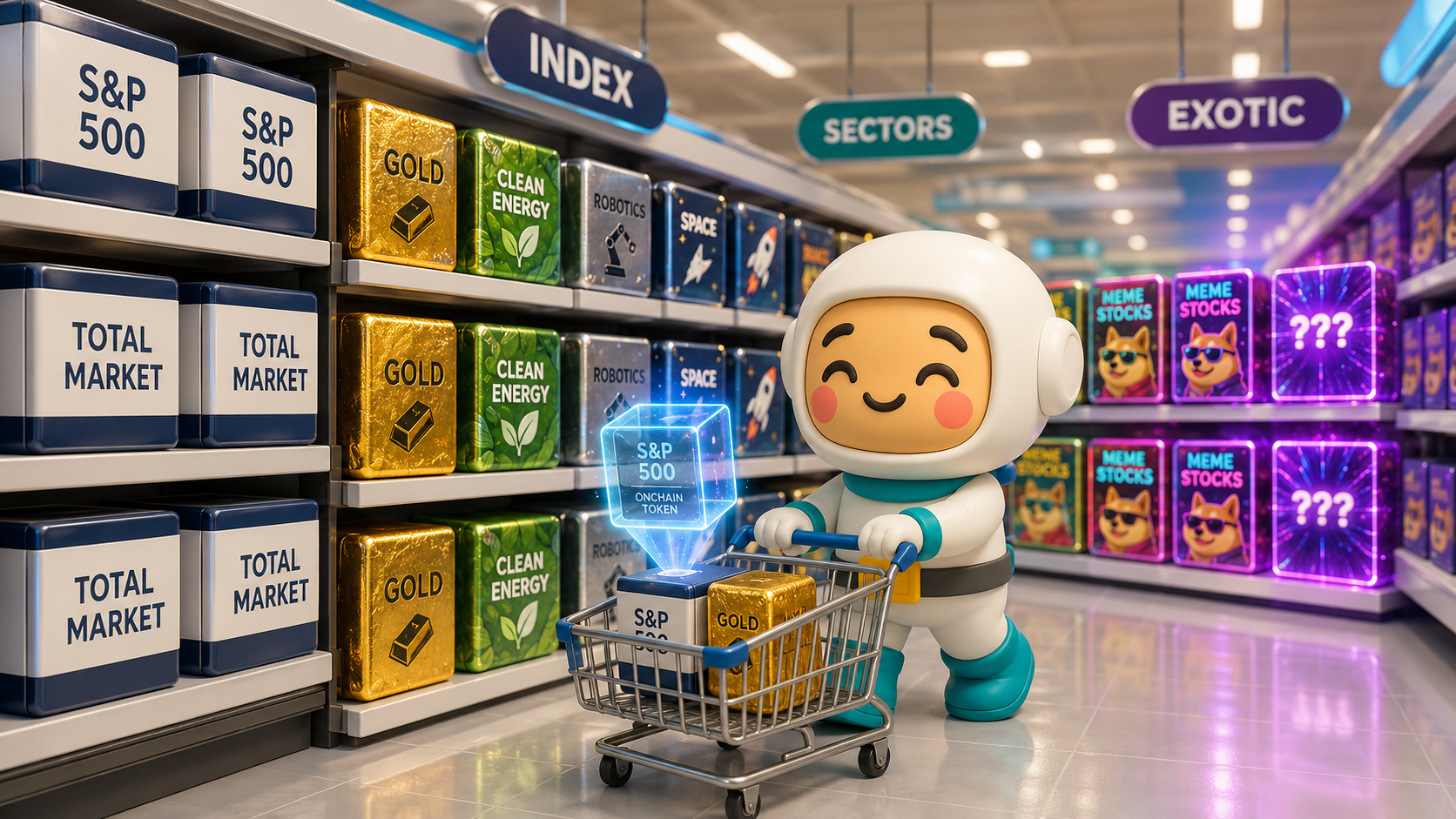
Ask someone what an ETF is and they'll probably mention the S&P 500. Ask them to name one and they'll probably say SPY. That's fair — index ETFs tracking major US benchmarks are where most people start, and for good reason. They're simple, low-cost, and widely available.
But they're also just the beginning.
The ETF structure — a fund that holds a basket of assets and trades on an exchange like a stock — has proven remarkably flexible. Since the first ETF launched in 1993, the industry has expanded to cover virtually every asset class, investment strategy, sector, and niche imaginable. Today there are thousands of ETFs, ranging from the boringly sensible to the genuinely bizarre. Now many of these ETFs are also tokenized onchain so you can hold them in a self custody wallet. Understanding what's out there is the first step to evaluating what might actually belong in your portfolio.
This article is for educational purposes only and does not constitute financial advice. All investments carry risk. Always conduct your own research before making any financial decisions.
Jump To:
- A Quick Recap: What Makes Something an ETF
- Stock ETFs
- Bond ETFs
- Commodity ETFs
- Dividend ETFs
- Leveraged and Inverse ETFs
- Thematic and Sector ETFs
- Crypto ETFs
- The Niche and Unusual: When ETFs Get Weird
- What to Watch Out For
- The ETF Universe Is Bigger Than You Think
A Quick Recap: What Makes Something an ETF
An ETF (Exchange-Traded Fund) is an investment fund that holds a collection of assets and trades on a stock exchange throughout the day, just like a regular stock. When you buy shares of an ETF, you're buying exposure to everything inside it — without having to purchase each asset individually.
ETFs are now available onchain as well. Many of the most popular ETFs, including stocks, bonds, commodities, and more, may now be stored as tokens in a self-custodial cryptocurrency wallet, right next to your Bitcoin or Ethereum, thanks to tokenization. Although there isn't yet a tokenized equivalent for every ETF, the collection is expanding quickly. Using MEW, you can trade to a wide range of the available tokenized ETFs via our Ondo Stocks integration.
For a fuller introduction to how ETFs work, check out our guide to ETFs.
Stock ETFs
Stock ETFs are the most familiar category and where most investors begin. They hold shares of publicly traded companies and can be structured in several ways.
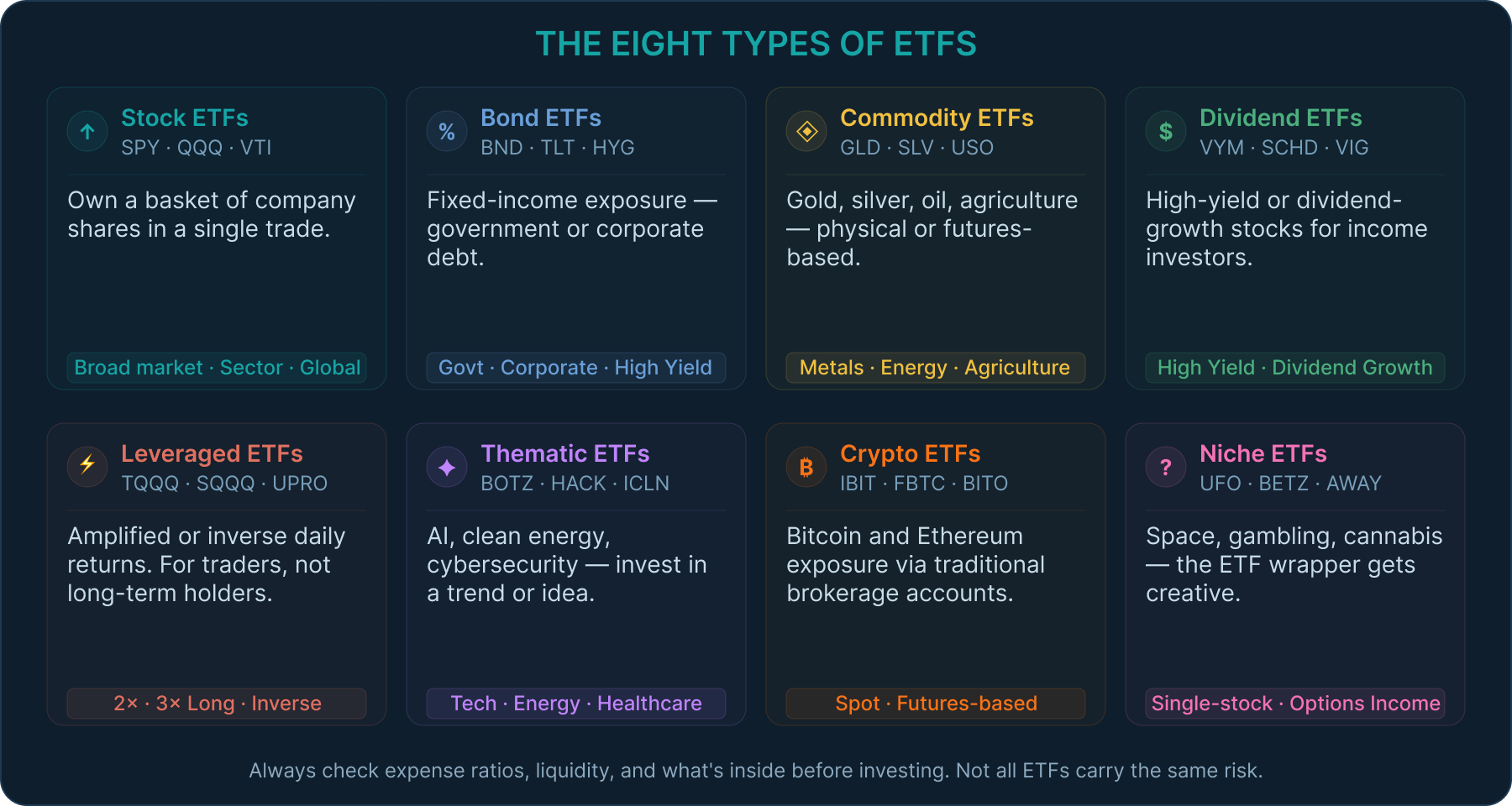
Broad market ETFs aim to capture the performance of an entire market. The SPDR S&P 500 ETF Trust (SPY) tracks the 500 largest US companies. Vanguard Total Stock Market ETF (VTI) goes even wider, covering thousands of US companies across all sizes. Invesco QQQ Trust (QQQ), which tracks the Nasdaq-100, sits somewhere in between — it's index-based and widely held, but concentrated in the 100 largest non-financial Nasdaq companies, giving it a heavy technology lean. These are the workhorses of long-term, passive investing.
Sector ETFs narrow the focus to a specific industry. Technology (XLK), healthcare (XLV), financials (XLF), energy (XLE) — there's a sector ETF for most major industries. These are useful for investors who want to overweight or underweight a particular part of the economy without picking individual stocks.
International and emerging market ETFs provide exposure outside the US. iShares MSCI Emerging Markets ETF (EEM) covers developing economies like China, India, and Brazil. iShares MSCI EAFE ETF (EFA) covers developed markets in Europe, Asia, and Australia. For investors who believe global diversification matters — and historically it does — these fill an important role.
Some tokenized stock ETFs that you can hold in your crypto wallet: SPYon (SPDR S&P 500 ETF), QQQon (Invesco QQQ), VTIon (Vanguard Total Stock Market), EEMon (iShares MSCI Emerging Markets) — all available on MEW Portfolio and MEW Mobile.
Bond ETFs
Bond ETFs hold fixed-income securities — debt instruments issued by governments, corporations, or municipalities that pay regular interest. They've made bond investing far more accessible to retail investors, who previously had to buy bonds individually through a broker.
Government bond ETFs hold debt issued by national governments. iShares 20+ Year Treasury Bond ETF (TLT) focuses on long-duration US Treasuries, making it sensitive to interest rate movements. iShares Short Treasury Bond ETF (SHV) holds short-term Treasuries — much more stable, lower yield.
Corporate bond ETFs hold debt issued by companies. Vanguard Total Bond Market ETF (BND) covers a broad mix. iShares iBoxx $ High Yield Corporate Bond ETF (HYG) focuses on so-called "junk bonds" — higher-yield debt from companies with lower credit ratings. Higher potential returns, but more risk.
Duration matters more than most people realise. Long-duration bond ETFs like TLT are significantly more sensitive to interest rate changes than short-duration ones. When rates rise, long-duration bond prices fall — sometimes sharply. Understanding duration is essential before buying a bond ETF.
Some tokenized bond ETFs that you can hold in your crypto wallet: TLTon (iShares 20+ Year Treasury), SHYon (iShares 1-3 Year Treasury), HYGon (iShares High Yield Corporate Bond), AGGon (iShares Core US Aggregate Bond) — all available on MEW Portfolio and MEW Mobile.
Commodity ETFs
Commodity ETFs provide exposure to physical goods — metals, energy, agriculture — without requiring you to store barrels of oil or bars of gold.
Precious metals ETFs are the most popular. SPDR Gold Shares (GLD) is backed by physical gold held in vaults, meaning the ETF's value tracks the gold price directly. iShares Silver Trust (SLV) does the same for silver.
Energy commodity ETFs like United States Oil Fund (USO) work differently — they typically hold futures contracts rather than physical oil. This creates a complexity called contango, where the rolling of futures contracts from month to month can erode returns over time even if the underlying commodity price stays flat. It's an important distinction that catches many investors off guard.
Agriculture ETFs cover commodities like wheat, corn, soybeans, and coffee. These tend to be more volatile and more affected by weather, geopolitics, and supply chain factors than other commodity categories.
Some tokenized commodity ETFs that you can hold in your crypto wallet: GLDon (SPDR Gold Shares), IAUon (iShares Gold Trust), SLVon (iShares Silver Trust), USOon (US Oil Fund) — all available on MEW Portfolio and MEW Mobile.
Dividend ETFs
Dividend ETFs specifically target companies that pay regular dividends to shareholders — making them popular with income-focused investors who want cash flow from their portfolio rather than just price appreciation.
Vanguard High Dividend Yield ETF (VYM) and Schwab US Dividend Equity ETF (SCHD) are among the most widely held. They tend to weigh heavily toward mature, established companies in sectors like utilities, consumer staples, and financials — industries known for consistent payouts.
The trade-off is that dividend-focused ETFs often underperform growth-heavy indexes during bull markets, since high-growth companies typically reinvest profits rather than paying them out. The appeal is stability and income — particularly for investors in or approaching retirement.
A related category worth knowing: dividend growth ETFs, which focus on companies that have consistently increased their dividends over time, rather than simply paying the highest current yield. Vanguard Dividend Appreciation ETF (VIG) is a prominent example.
Some tokenized dividend ETFs that you can hold in your crypto wallet: QYLDon (Nasdaq-100 Covered Call ETF), XYLDon (S&P 500 Covered Call ETF), DGRWon (WisdomTree US Quality Dividend Growth) — all available on MEW Portfolio and MEW Mobile.
Leveraged and Inverse ETFs
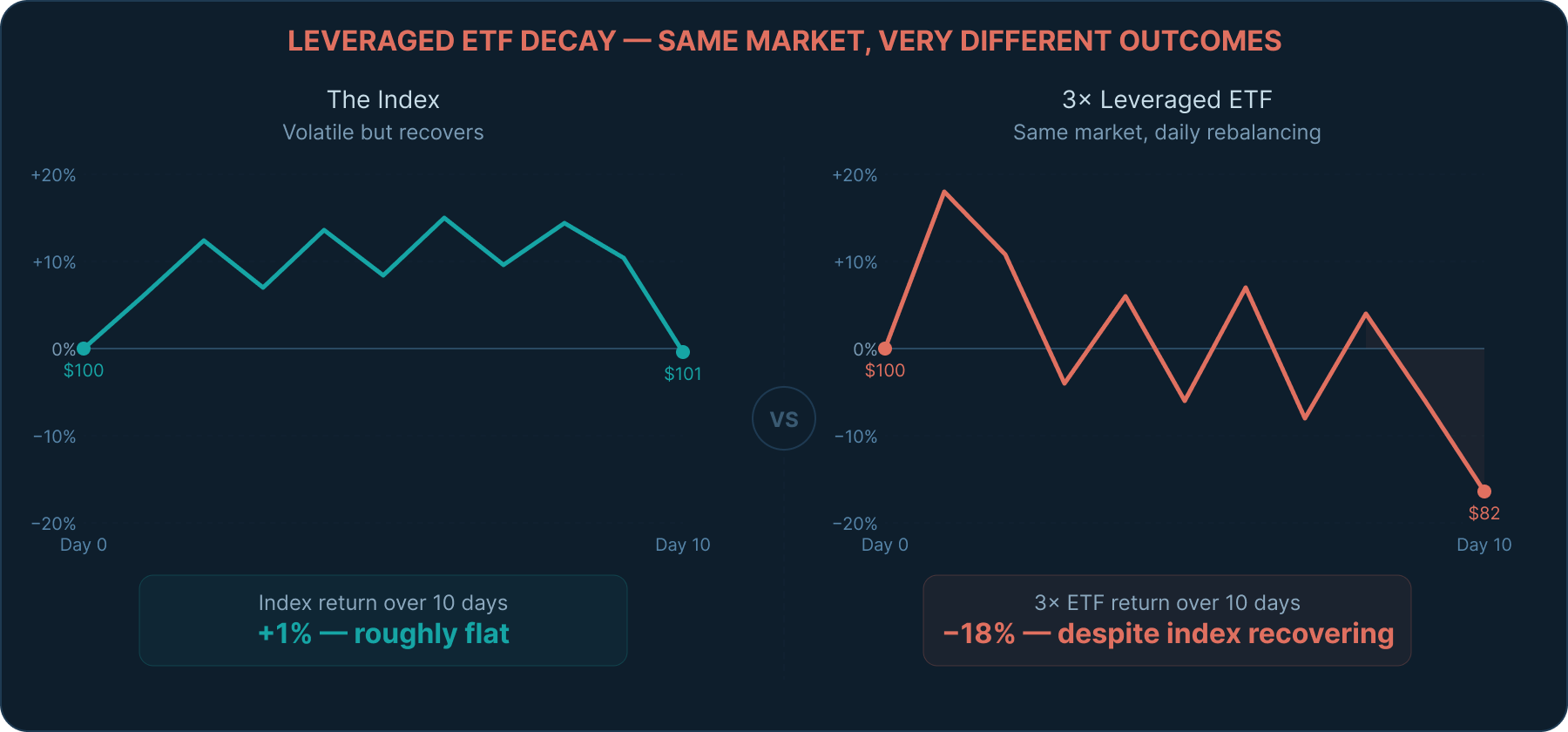
Leveraged ETFs use financial derivatives to amplify the daily returns of an index. ProShares UltraPro QQQ (TQQQ) aims to deliver 3x the daily return of the Nasdaq-100. If the Nasdaq rises 1% in a day, TQQQ aims to rise 3%. If it falls 1%, TQQQ aims to fall 3%.
The critical word is daily. Leveraged ETFs reset their leverage every single day, which means they behave very differently over longer periods than their name implies. A phenomenon called volatility decay (or beta slippage) means that in choppy or sideways markets, leveraged ETFs can lose value even if the underlying index ends up roughly flat. They are not designed to be held long-term and are primarily used by short-term traders.
Inverse ETFs work in the opposite direction — they aim to profit when an index falls. ProShares Short QQQ (SQQQ) gains when the Nasdaq falls and loses when it rises. These are used as hedging tools or short-term bearish bets, not as buy-and-hold positions.
Both leveraged and inverse ETFs carry significant risks that are poorly understood by many retail investors. They are powerful instruments in the right hands — and dangerous ones in the wrong ones.
Some tokenized leveraged and inverse ETFs that you can hold in your crypto wallet: TQQQon (ProShares UltraPro QQQ 3x), SQQQon (ProShares UltraPro Short QQQ), SOXLon (Direxion Daily Semiconductors 3x) — all available on MEW Portfolio and MEW Mobile.
Thematic and Sector ETFs
Thematic ETFs take sector investing a step further, targeting specific trends, technologies, or ideas rather than established industries.
Clean energy (iShares Global Clean Energy ETF — ICLN), robotics and AI (Global X Robotics & Artificial Intelligence ETF — BOTZ), cybersecurity (ETFMG Prime Cyber Security ETF — HACK), genomics (ARK Genomic Revolution ETF — ARKG) — the list is long and growing.
The appeal is obvious. If you believe AI is going to transform the global economy, a thematic AI ETF lets you bet on that thesis across dozens of companies at once, without needing to pick the individual winners.
The risks are also real. Thematic ETFs tend to have higher expense ratios than broad market funds. They can be heavily concentrated in a small number of holdings. And themes that seem inevitable at the top of a bull market have a habit of underperforming for years before (or instead of) delivering on their promise. ARK's funds, which saw enormous inflows in 2020-2021, are a useful case study in the risks of thematic investing.
Some platforms are also beginning to let investors build their own custom baskets — essentially DIY ETFs where you choose the companies and weightings yourself. It's an appealing idea, and the flexibility is real, but so are the risks: without the discipline of an index methodology or professional oversight, custom baskets can quickly become concentrated bets dressed up as diversification.
Some tokenized thematic and sector ETFs that you can hold in your crypto wallet: BOTZon (Global X Robotics & AI ETF), IYWon (iShares US Technology ETF), CIBRon (ETFMG Prime Cyber Security ETF), LITon (Global X Lithium & Battery Tech ETF) — all available on MEW Portfolio and MEW Mobile.
Crypto ETFs
Crypto ETFs have arrived in force, giving traditional investors exposure to digital assets through familiar brokerage accounts without needing a crypto wallet.
Spot Bitcoin ETFs — launched in the US in January 2024 after years of regulatory resistance — hold actual Bitcoin. BlackRock's iShares Bitcoin Trust (IBIT) and Fidelity's Wise Origin Bitcoin Fund (FBTC) are the largest. Their launch was a significant moment, bringing institutional and retail capital into Bitcoin through a regulated, custodied product for the first time.
Futures-based crypto ETFs like ProShares Bitcoin Strategy ETF (BITO) were available to investors earlier than spot ETFs, but hold Bitcoin futures contracts rather than Bitcoin itself. As with oil futures ETFs, the rolling of contracts introduces costs that can cause the ETF to underperform the spot price of Bitcoin over time.
Spot Ethereum ETFs followed Bitcoin ETFs in mid-2024, with similar structures and a similar set of issuers. Since then the crypto ETF landscape has expanded rapidly. Spot Solana ETFs were approved in October 2025, with XRP ETFs following shortly after in late 2025. Litecoin and Hedera ETFs have also launched, and multi-asset crypto index ETFs — holding a basket of cryptocurrencies in a single product — are beginning to emerge. Further down the pipeline, filings exist for Dogecoin, Cardano, Avalanche, and Polkadot ETFs, suggesting the crypto ETF space is still very much in its early chapters.
The trade-off with crypto ETFs compared to holding crypto directly is custody and composability. With an ETF, you don't own the underlying Bitcoin — a custodian holds it on behalf of the fund. You can't send it, use it in DeFi, or hold it in a self-custodial wallet. For investors who simply want price exposure and are comfortable with that trade-off, ETFs are a legitimate and accessible option. For those who want the full benefits of self-custody and on-chain composability, holding crypto directly — or via tokenized real-world assets — remains the golden standard.
Some tokenized crypto ETFs that you can hold in your crypto wallet: IBITon (iShares Bitcoin Trust), ETHAon (iShares Ethereum Trust) — all available on MEW Portfolio and MEW Mobile.
The Niche and Unusual: When ETFs Get Weird
The ETF wrapper has proven so flexible that it now covers territory that would have seemed absurd a decade ago.
ETFMG Travel Tech ETF (AWAY) launched just before COVID-19 devastated global travel. Roundhill Sports Betting & iGaming ETF (BETZ) covers the gambling industry. Procure Space ETF (UFO) focuses on companies involved in space exploration and satellite technology. Sprott Junior Uranium Miners ETF (URNJ) targets small uranium mining companies. There are ETFs for cannabis, video games, pet care, obesity drugs, and even longevity research.
More recently, single-stock ETFs have emerged — leveraged or inverse ETFs tied to a single company's stock rather than an index. Want 2x the daily return of Tesla? There's an ETF for that (TSLT). These push the ETF wrapper into territory that many market observers consider genuinely concerning, given the risks to retail investors who may not fully understand what they're buying.
Perhaps the most niche recent example is the Defiance R2000 Enhanced Options Income ETF and similar "options income" ETFs, which use complex covered call and put strategies to generate yield — products that package institutional-grade derivatives strategies into a retail-friendly wrapper, for better or worse.
Even the classic ETFs are shifting. SpaceX's addition to the Nasdaq-100 — and by extension QQQ — bypassed the usual profitability and listing requirements, while the S&P 500 held firm on its stricter standards. For QQQ investors, that means exposure to a high-growth, unconventional name inside what many treat as a straightforward index product. What's inside even the most familiar ETFs isn't always as predictable as the ticker suggests.
The growth of these products says something important about the ETF industry: it is fundamentally a distribution mechanism. If there's investor demand for exposure to a theme, a strategy, or an asset class, someone will build an ETF around it. Whether that ETF is a sensible investment is a separate question entirely.
Some tokenized niche ETFs that you can hold in your crypto wallet: SOXXon (iShares Semiconductor ETF), ITAon (iShares US Aerospace & Defense ETF), VNQon (Vanguard Real Estate ETF), OIHon (VanEck Oil Services ETF) — all available on MEW Portfolio and MEW Mobile.
What to Watch Out For
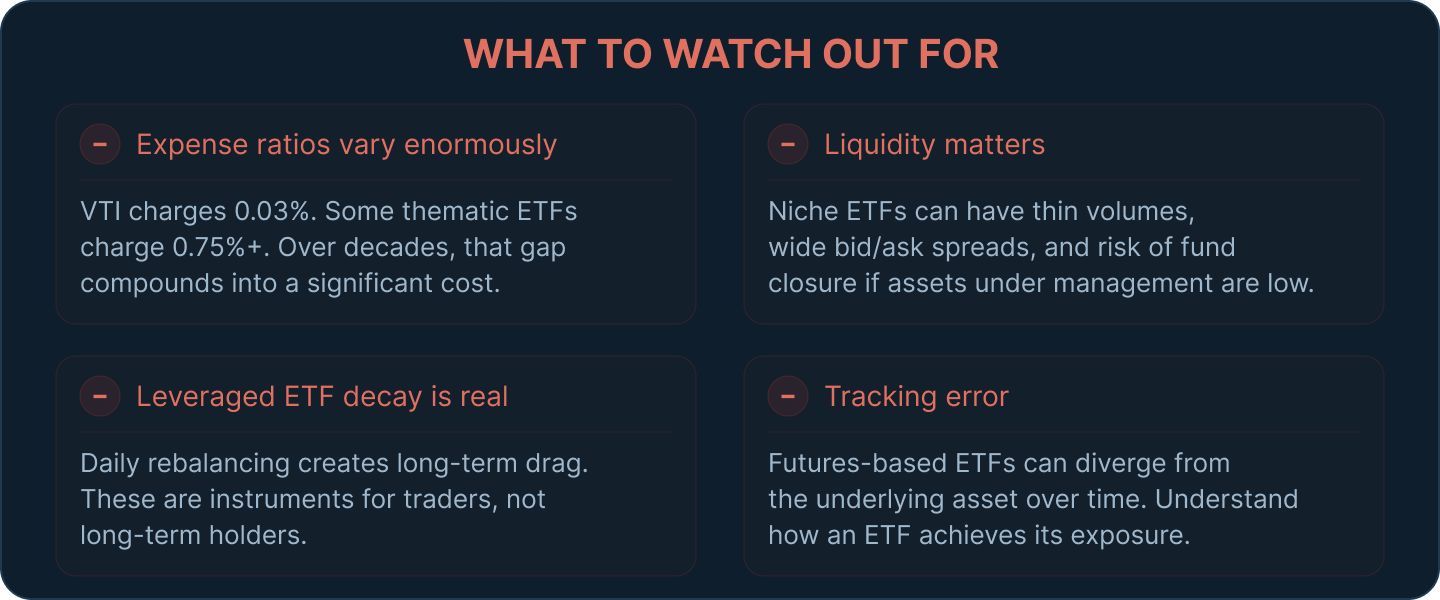
Across all ETF categories, a few consistent risk factors are worth keeping in mind.
Expense ratios vary enormously. A broad market ETF like VTI charges 0.03% annually. Some thematic or actively managed ETFs charge 0.75% or more. Over decades, that difference compounds significantly. Always check the expense ratio before buying.
Liquidity matters. The largest ETFs — SPY, QQQ, GLD — trade billions of dollars daily with tight bid/ask spreads. Smaller, niche ETFs may have thin trading volumes, wide spreads, and the risk that the fund gets shut down due to insufficient assets under management. If an ETF has less than $50–100 million in assets, it warrants extra scrutiny.
Leveraged ETF decay is real. As described above, daily-resetting leverage creates a long-term drag in volatile markets. These are instruments for traders, not long-term holders.
Tracking error. Not all ETFs perfectly track their stated index or benchmark. Futures-based commodity and crypto ETFs in particular can diverge meaningfully from the underlying asset price over time. Understanding how an ETF achieves its exposure is as important as understanding what it's exposed to.
The ETF Universe Is Bigger Than You Think
What started as a simple idea — a fund that trades like a stock — has grown into one of the most versatile investment vehicles ever created. From US government bonds to uranium miners to space companies to Bitcoin, the ETF wrapper now touches almost every corner of the investable universe.
That breadth is genuinely useful. It means investors of all types — whether focused on income, growth, hedging, speculation, or simply matching the market — can find an ETF built around their goals. It also means the due diligence required before buying any given ETF is more important than ever. Not all ETFs are created equal, and the familiar structure can obscure very different levels of risk, cost, and complexity underneath.
Knowing the categories is the starting point. Understanding what's inside any ETF you're considering is the work that matters.
Thank you for checking out our article on The Different Types of ETFs! Make sure to follow us on X(Twitter) and let us know your thoughts. MEW rewards active traders — see our Rewards page for all ongoing campaigns. Sign up for our newsletter to stay up to date with MEW releases, and check out our weekly podcast Crypto Currents for the latest news in crypto. For more on ETFs and how they're evolving on-chain, check out our article on What Are ETFs? and What are Real-World Assets (RWAs).